
Livingston Runs on Propane
Livingston Essential Transportation Service (LETS) serves 157,000 trips per year in Livingston County (about 585 square miles), and they use a propane paratransit vehicle fleet to make it possible. After comparing several options, the LETS team chose propane as the best fit for their operation.
“Before I was deputy director of LETS, the previous management had been paying attention to propane. And they were the ones who were instrumental in setting it up and maximizing its benefits,” said Adam Baranski in an interview with the Michigan Propane Gas Association. “So currently we have 16 propane vehicles, and we would actually love to get away from any of our diesel vehicles and convert the entire fleet over to propane,” he told us.
Baranski explained what convinced LETS to adopt propane: “I drove for LETS transportation for nine and a half years. Watching from a management standpoint, the maintenance costs go down, the availability for cleaner vehicles, and just the general consensus of having the tax credit was also a very big help.”

- Propane Transit Bus Fleet: 16 vehicles
- Savings: $1/gallon savings over unleaded price
- CO2 emission reduction – over 850,000 lb CO2 / yr.
Propane Saves Public Transit Fleets Money
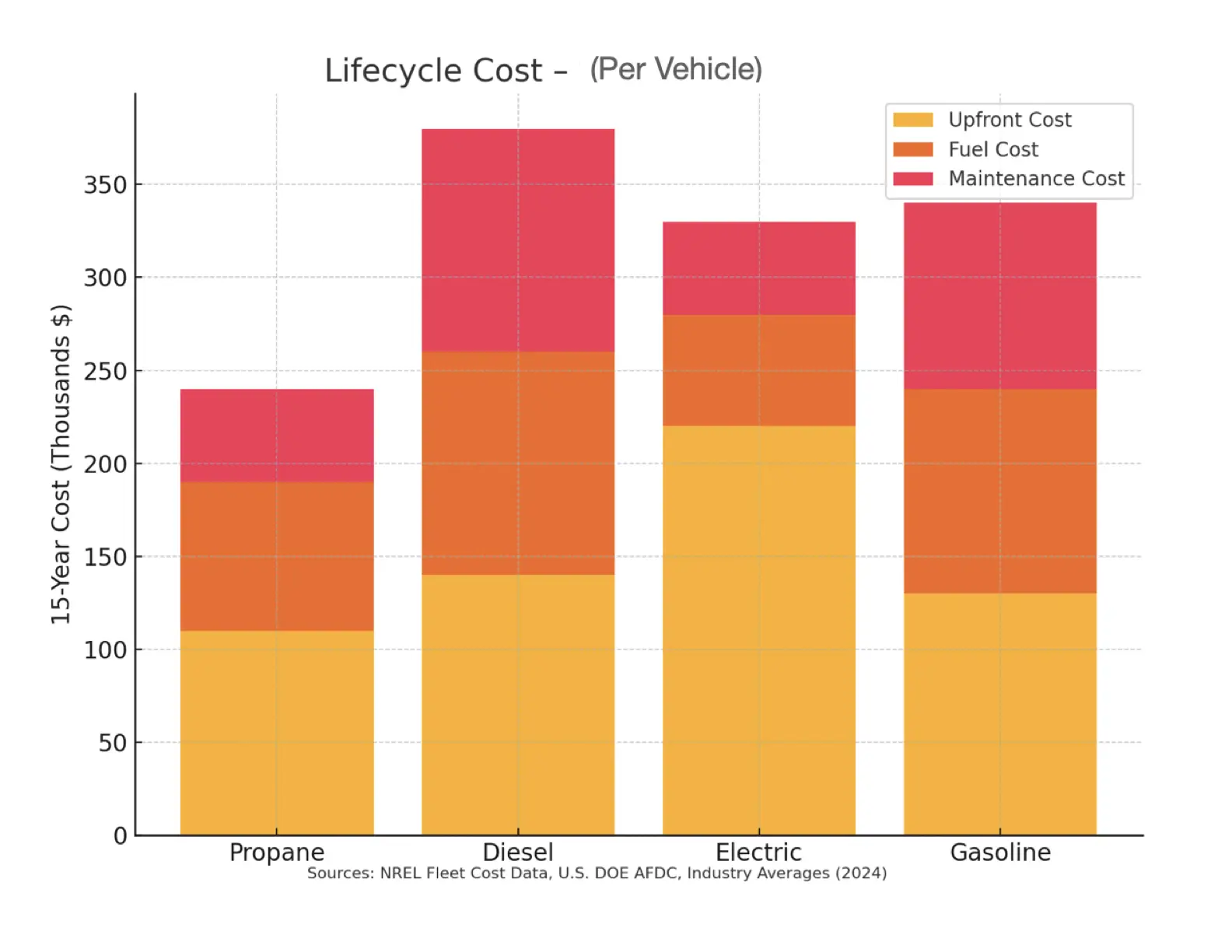
Propane is an incredibly affordable option for transportation fleets. Compared with diesel and gasoline-powered buses, propane buses cost less to fuel and maintain. “It is close to a dollar a gallon difference,” said Baranski.
Propane pricing is more stable than gasoline, which helps fleets plan budgets with fewer surprise spikes. It’s purchased as a commodity where the price per gallon is much lower than that of other fuel types. The U.S. Department of Energy’s Clean Cities and Communities Alternative Fuel Price Report notes that, historically, propane prices have been much more stable, with fewer swings compared to gasoline and diesel.
Propane-fueled bus fleets require less maintenance than diesel models. Its low-carbon qualities mean significantly less carbon buildup in the engine, therefore less overall maintenance. Baranski noted, “The maintenance is a lot lower. Looking from a miles/vehicle perspective, we can see the buses are lasting longer as well.” Propane’s reliability in day-to-day operations helps reduce costs and helps to keep fares affordable.
Click Image to Enlarge
Propane Offers Cleaner, Lower-Emission Transit
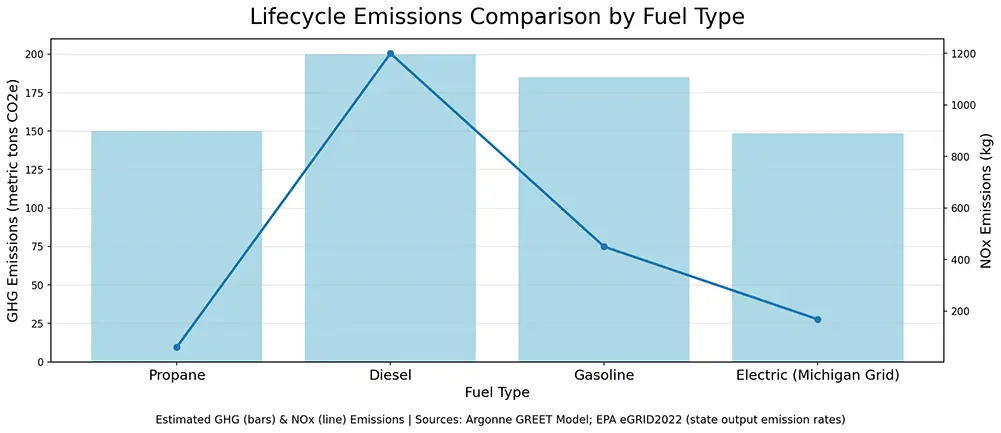
Propane is a nontoxic, low-emission fuel. It doesn’t contaminate air, soil, or groundwater. It’s listed as an alternative fuel under the Energy Policy Act of 1992 and is “low-emission,” emitting significantly fewer greenhouse gases and harmful pollutants than gasoline- and diesel-powered vehicles. It’s the third most widely used transportation fuel in the world (right behind gasoline and diesel) and has been around for over 100 years, and 97% of it is made in the U.S.
“Diesel buses are just dirty and not good for the environment. They unfortunately have horrible emissions,” said Baranski, who also noted the effects of the engines while idling: “a complete waste of energy and just horrible for the environment.”
Click Image to Enlarge
According to the U.S. Department of Energy Alternative Fuels Data Center (AFDC), propane buses emit up to 96% less nitrogen oxides than diesel buses. These harmful pollutants are associated with respiratory issues. By switching to propane, Livingston helps protect residents’ health while reducing its carbon footprint. Baranski reported that by switching to propane, LETS saves more than 850,000 pounds of CO2 per year compared to gasoline.
“I love propane vehicles because of the dependability of the vehicle. It starts every time. I know the passengers are going to be safe.”
Adam Baranski, Deputy Director
Propane Winter-Ready
LETS knew the buses would need to be able to hold up to Michigan’s winter weather.
“One of the concerns when switching to propane vehicles was when we had snow days or severe weather. We actually park them at off-site locations without overnight coverage, and there are no concerns. The vehicle fires up right away, no plugging in, nothing concerning like that, like we used to have to do.”
Diesel engine blocks have to be plugged in at night to keep warm to start in winter mornings, not a problem for propane, as Baranski stated.
Propane engines also warm up faster, which means consistent heat for drivers and passengers even on the coldest Michigan mornings. In fact, Baranski commented on propane buses’ heating advantages over diesel, “We have someone who resides in a wheelchair, you open up the side door, you let out all the heat, and then of course it takes a long time to acclimate again to have heat in the bus. With a propane vehicle, the heat is right away.”
Safe Transportation Offered by Propane
There are over 20 transit agencies using propane fleets to transport their local residents, which make up the 30,000+ propane-powered vehicles on Michigan roads. Propane provides a remarkably quiet ride, enabling greater communication between drivers and passengers. Baranski told MPGA that when he was a driver, there were concerns about whether the buses in their fleet would have enough acceleration to merge safely onto the freeway. LETS found that propane buses accelerate better, making freeway merges easier and far safer.
Propane fuel tanks are engineered for safety. They are constructed from carbon steel, they’re 20 times more puncture-resistant than gasoline or diesel tanks. Each tank is built to meet rigorous standards set by the American Society of Mechanical Engineers, ensuring long-lasting durability.
Propane also offers added safety at the pump. Using propane doesn’t require Personal Protective Equipment (PPE) to fill a propane fuel tank when using the Type K15 or Euro style nozzle at the pump. In addition, every propane fueling station features a built-in lock-off valve that automatically stops fuel flow if a pressure drop is detected, providing an extra layer of protection for fleets.
Propane: An Easy Upgrade
Transitioning a fleet to propane is straightforward. In most cases, you’re talking about an on-site tank (or tanks), a dispenser, and the basic site prep to support it. Depending on the configuration, fleets can choose on-site, or public fueling options, so you’re not locked into a single approach.
“Most people, when they first hear the word propane, they think that it’s going to be some crazy spec, but absolutely easy to do. I mean, it’s just a nozzle, push it in, pull a handle, fuel it just like you would every time that you go to the gas station. We used a third-party service, a local company, which gave us some of the specs for the weight of the tank, and so once we figured out that, we just had to put the concrete down. A couple of hours later, we had propane on the property. I couldn’t believe it.”
“I would not be hesitant if I were to start a new transit agency to jump into propane again. It’s definitely something that’s been a win for LETS Transportation.”
The Michigan Propane Gas Association is Offering $6,000 Rebates
Using propane can help save your transit’s budget. The Michigan Propane Gas Association also offers fleets up to $6,000 to first-time users of propane. The MPGA’s propane-fleet experts help fleet directors, treasurers, and city officials make the transition to propane a smooth one.
Learn more at: MiAutogas.com/#funding