
Propane Powers Greater Lapeer Transit
Michigan’s Lapeer County operates the Greater Lapeer Transportation Authority (GLTA), a rural transportation service covering approximately 647 square miles, using propane-powered paratransit vehicles. In 2019, Kelly Bales, Executive Director, began researching a fuel that would give her fleet the cost savings they needed. After comparing several options, they went with propane. By the end of 2019, they purchased their first propane paratransit bus.
“We had had diesel before, and it was very expensive for us,” said Bales in an interview with the Michigan Propane Gas Association. “The diesel was very costly not only for the fuel, but also for all of our maintenance. If we had to do a full engine repair, the cost would have been phenomenal. So, with looking at the option of propane, that gave us the savings that we were looking for and needed for a rural transit.”
Today, GLTA operates 6 propane paratransit vehicles. Looking to expand, they intended to purchase six more propane buses, but COVID interrupted their plans; purchasing more propane vehicles is in their future.

- Propane Transit Bus Fleet: 6 vehicles
- Savings: 43% on Fuel and Maintenance
- CO₂ emission reduction – over 320,00 lb CO₂ / yr
Propane Cuts Costs for Public Transit Fleet Operations
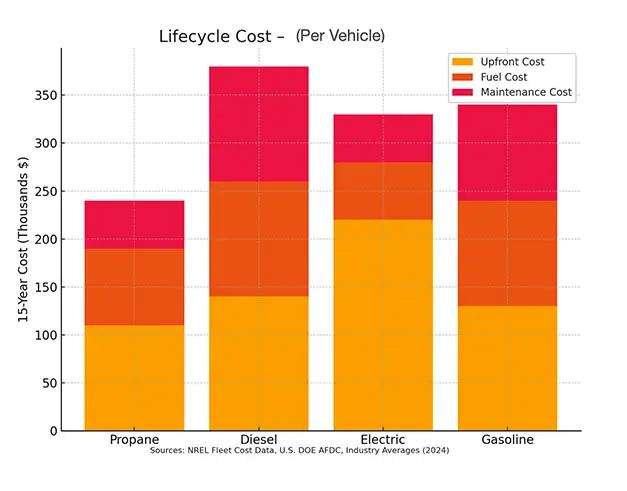
Propane is a smart fuel choice for transportation fleets. Compared with diesel- and gasoline-powered buses, propane buses are significantly less expensive to fuel and maintain.
“I did a cost analysis, and our savings between fuel and maintenance are 43% less with propane as compared to our diesel expenses,” said Bales.
Propane pricing is more stable than gasoline, which helps fleets plan budgets with fewer surprise spikes. It’s purchased as a commodity, with a price per gallon much lower than that of other fuel types. The U.S. Department of Energy’s Clean Cities and Communities Alternative Fuel Price Report notes that, historically, propane prices have been much more stable, with fewer swings compared to gasoline and diesel.
Bales reported, “In 2025, GTLA used 15,000 gallons of gas and 5,500 gallons of propane – ⅓ of fuel consumption is propane – and with that alone, the cost savings are phenomenal.”
Click Image to Enlarge
Currently, GLTA has to fuel its gasoline units at public gas pumps, which means it is at the mercy of daily pump prices, and right now, that cost is over $4.00 per gallon, whereas propane is at a stable price of nearly ⅔ less than the price/gallon with its local propane supplier.
Propane’s low-carbon qualities mean significantly less carbon buildup in the engine, therefore less overall maintenance. Bales noted, “The maintenance department loves that [propane] is a clean fuel. So, that means that it’s a clean engine. As for our oil changes, the oil comes out completely clean, which makes that portion of the service very nice. It’s been heaven-sent as far as the work that they’ve had to do.”
Why Propane Fits with Lower-Emission Transits
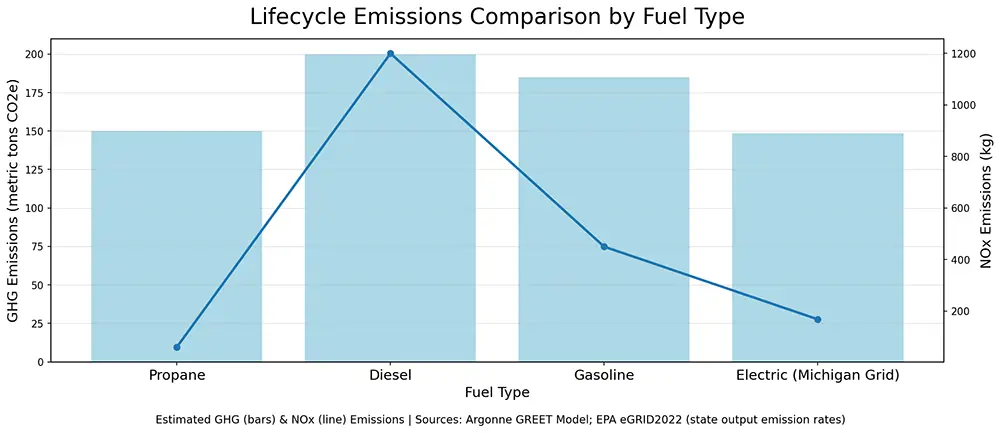
Propane is a nontoxic, low-emission fuel. It doesn’t contaminate air, soil, or groundwater. Recognized as an alternative fuel under the Energy Policy Act of 1992, propane is a low-emission option that produces substantially fewer greenhouse gases and harmful pollutants than gasoline- and diesel-powered vehicles. It has been used for more than 100 years, ranks as the third most widely used transportation fuel in the world, and 97% of it is produced in the United States.
“The performance of propane is no different than any one of our other fuel options. Again, the positive with the propane is that the odor is not there, like it is for diesel or gasoline. That means no odor for the drivers and the passengers.”
Click Image to Enlarge
According to the U.S. Department of Energy Alternative Fuels Data Center (AFDC), propane buses emit up to 96% less nitrogen oxides than diesel buses. These harmful pollutants are associated with respiratory issues. By switching to propane, Lapeer helps protect residents’ health while reducing its carbon footprint. Bales reported that by switching to propane, GLTA saves more than 320,000 pounds of CO₂ per year compared to gasoline.
“The environment is very important to us here in a rural community, so we want to make sure that we are doing our best to be able to provide it for all of our passengers. We’re putting our best foot forward so the community knows we are looking out for their best interests. And propane buses are 100% the way to do that.”
“I love propane vehicles because of the cost savings first and foremost, and emissions that we know that we’re using a clean fuel out there for our future and our children’s future.”
Kelly Bales, Executive Director
Propane Winter-Ready
Michigan winters are no joke, and GLTA made sure to account for that reality in its fleet decisions.
Bales commented on propane buses’ heating advantages over diesel.
“It [propane buses] heats up in the wintertime, which we have had a very strong winter this year. The drivers loves that feature and so do our passengers, so that’s an added bonus for us.”
Why Propane Is a Safe Transportation Fuel
More than 20 transit agencies in Michigan use propane-powered fleets to move their local residents, contributing to the more than 30,000 propane vehicles on the state’s roads. Propane vehicles have built-in safety features.
Propane offers a notably quiet ride, making it easier for drivers and passengers to communicate.
Propane fuel tanks are engineered for safety. They’re constructed from carbon steel, and are 20 times more puncture-resistant than gasoline or diesel tanks. Each tank is built to meet rigorous standards set by the American Society of Mechanical Engineers, ensuring long-lasting durability.
Propane safety is built-in at the pump. Using propane doesn’t require Personal Protective Equipment (PPE) to fill a propane fuel tank when using the Type K15 or Euro style nozzle at the pump. In addition, every propane fueling station features a built-in lock-off valve that automatically stops fuel flow if a pressure drop is detected, providing an extra layer of protection for fleets.
Propane Makes Fleet Upgrades Easy
Switching a fleet to propane is relatively simple. It involves installing an on-site tank or tanks, a dispenser, and the basic site preparation needed to support fueling. Depending on the fleet’s needs, organizations can choose either on-site fueling, public fueling, or a mix of both, so you’re not locked into a single approach.
GLTA does not have on-site fueling at its location; it is fueled with “mobile” fueling. This is where Lapeer’s propane supplier will come to their location every morning with a bobtail truck and fuel their propane vehicles.
“We do have a couple of facilities around the county that if we did need to refuel, mid-shift, then we could do that. And historically, since we started the fueling in the morning, it’s all we’ve needed to do,” said Bales.
Meaning one fuel in the morning can last all day, when they are driving an average of 120 to 130 miles per day per vehicle, that can make a big difference.
Bales had this advice for other fleets thinking about making the switch to propane, “Doing the research is very important, just looking at the cost savings, both the fuel and then also for the maintenance side of it. But talking to other paratransits that have already been operating in the propane features out there on the buses, we can give them those numbers, and the good, hard numbers are good to see if that’s going to be a positive for their fleet.”
The Michigan Propane Gas Association is Offering $6,000 Rebates
Using propane can help save your transit’s budget. The Michigan Propane Gas Association is offering transportation directors up to $6,000 to first-time users of propane. The MPGA’s propane-fleet experts help fleet directors, treasurers, and city officials make the transition to propane a smooth one.
Learn more at: MiAutogas.com/#funding