Propane, Bringing Savings and Green Energy to Benzie County
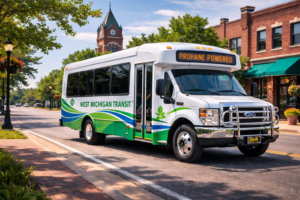
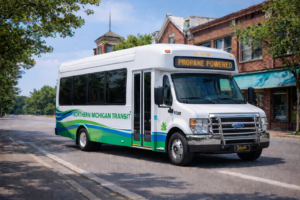
Benzie Bus, a public transit system serving Benzie County, serves residents within 320 square miles, including several neighboring counties. Their propane story started as a simple “let’s try it and see” experiment.
During an interview with the Michigan Propane Gas Association, Chad Hollenbeck, Operations Manager, noted, “Back around 2012, we were able to utilize some leftover grant funding that we had to dip our toes in the propane market. So we initially went out and converted five of our gasoline buses to propane as kind of a trial.”
Those early units were configured as bi-fuel, allowing the vehicles to run on propane and gasoline, giving the fleet. Hollenbeck said the trial went well and decided to expand their fleet. Today, they operate 12 dedicated propane buses (propane alone) and 9 bi-fuel buses. In 2025, the Benzie Bus fleet logged almost 121,000 trips and racked up just shy of 1 million miles.

Benzie Runs on Propane
- Propane Vehicles in Fleet: 21
- Savings: nearly 35% on fuel alone
- CO2 Emissions: Reduction of ~1.1 million lbs. of CO2 per year
Saving Money for Benzie County
From the beginning of the trial, Hollenbeck said there was “significant cost savings in fuel,” and that’s what pushed Benzie Bus to keep going with propane.
“Propane is 35% cheaper than what I’m paying for gasoline,” Hollenbeck mentioned. “The cost savings is significant.”
“Currently, our pricing sits at about $1.37 a gallon for propane. Gasoline, on the other hand, fluctuates a lot; we paid around $2.03 a gallon.”
Transportation directors are relieved to have a stable budget: “From a budget standpoint, our vendor has always been really good about locking in those prices for several months at a time. So we can plan the cost. Where gasoline and diesel are concerned, even though we may be buying them at a better price than what we see at the corner gas station, the fluctuations are constant. Propane has just been very steady.”
Once a transit system sees real savings and reliability on day-to-day operations, it’s hard to justify going back, especially when every dollar saved can help secure service and keep fares affordable.

Click Image to Enlarge
Propane is Green Energy
Propane buses in Benzie County are cutting down on CO₂, and that adds up fast when you’re running routes every day. Hollenbeck added, “We live in the most beautiful place in the world, and we try to do our part to keep up with that… Currently, our fleet saves around 1.1 million pounds of CO₂ annually.”
According to the EPA, Propane is a low-carbon, nontoxic alternative fuel and does not contaminate the air, soil, or groundwater. It’s the world’s third-most-common transportation fuel, behind gasoline and diesel.

Click Image to Enlarge
Because of propane’s “low-emission” qualities, it emits significantly fewer greenhouse gases and harmful pollutants than gasoline and diesel vehicles (U.S. Department of Energy). And for fleets that want to go even further on carbon intensity, DOE points out that renewable propane can have a much lower carbon intensity than conventional propane. In Benzie’s case, the takeaway is straightforward: the buses continue to perform the same job, but with a smaller CO₂ footprint per mile.
The smaller carbon footprint of propane-powered vehicles also helps companies comply with environmental regulations and climate action plans, and attract customers. On this point, Hollenbeck commented, “I think a passenger can appreciate that they know using Benzie Bus public transport that’s utilizing propane is helping the environment.”
“I love propane vehicles because they are a very reliable piece of our fleet.”
Chad Hollenbeck, Operations Manager
Propane Offers Safer, Quieter Buses
Over 20 transit agencies across the state use propane-powered fleets to transport local residents, comprising the 30,000+ propane-powered vehicles on Michigan roads.
Both fleet drivers and passengers prefer propane-powered transit vehicles for several reasons. For instance, propane provides a remarkably quiet ride, enabling greater communication between drivers and passengers.
“Our propane buses are not nearly as noisy as the diesel engines,” said Hollenbeck. With quieter operation, simpler maintenance, and safety-focused fuel system design, propane buses help Benzie County deliver safer, quieter transit for everyone on board.
Fuel tanks in propane vehicles are 20 times more puncture-resistant than those in gasoline and diesel vehicles. They are made from carbon steel, in accordance with the American Society of Mechanical Engineers, ensuring transportation durability and reliability.
Using propane doesn’t require Personal Protective Equipment (PPE) to fill a propane fuel tank with the Type K15 or Euro style nozzle at the pump. Additionally, every on-site propane fueling station is equipped with a lock-off valve that automatically shuts off the propane flow if a pressure drop is detected anywhere in the system, providing an extra layer of safety for transit fleets.
Propane Buses are Cold-Ready
A big test for any bus fleet in Benzie County is the weather. “I think the highest I’ve seen the temperature over the last couple of weeks has been 12 degrees,” said Hollenbeck in January 2026. “Last week we actually had wind chills hitting negative 25 degrees—and not a problem with any of the propane buses. About 65–70% of our fleet has to park outside, and they fire up just as easily as a gasoline engine.”
Up north, winter is a long season. When wind chills are pushing -20 to -35°F, “starts every time” matters a lot more than “nice to have.”
That’s where propane buses can really help. They start quickly in cold weather, warm up quickly, and maintain steady cabin heat without the winter issues that can knock buses out of service. For fleets, that means fewer no-start mornings, fewer weather-related delays, and less time chasing surprise maintenance issues, especially when the fleet sits outside overnight.
From Plan to Pump: Setting Up Propane Fueling
Propane fueling setups are more straightforward than people expect. In most cases, you’re talking about an on-site tank (or tanks), a dispenser, and the basic site prep to support it. Depending on the configuration, fleets can choose on-site fueling, or public fueling options, so you’re not locked into a single approach.
Benzie Bus found the on-site route pretty painless.
“It was actually a very easy process. We ultimately partnered with a local vendor. It was really simple. We provided a concrete slab and electricity, and they hooked everything else up, and they maintained everything,” said Hollenbeck. “We now have two 1,000-gallon propane tanks, and those are filled two to three times a week. It’s really been a benefit to have that onsite service so we can fuel those buses and everything’s right here at our facility.”
That “slab + power” description lines up with how permanent propane fueling stations are commonly installed: a concrete foundation, fuel storage, pumping/dispensing equipment, and the required safety protections.
When asked about training on how to fill a propane bus, Hollenbeck stated, “It’s very minimal training. The process is very simple. It just kind of clips on, and you squeeze the handle like you would at a gas pump. And when the bus is full, it clicks off.”
Holleback’s recommendation to fleet managers considering propane: “If you’re a fleet, and you’re interested in trying propane, call other people in the industry like me. I know some of these different manufacturers will offer tours in their plants so you can see how things are produced. And then reaching out and doing a little bit of homework on which propane vendors you have in your area and how they can service you.”


$6,000 Propane Vehicle Rebate Available from the Michigan Propane Gas Association
The Michigan Propane Gas Association is offering fleets up to $6,000 to first-time propane users. The MPGA’s propane-fleet experts are available to help fleet directors, treasurers, and city officials make the transition to propane a smooth one. Let propane help save your transportation budget while reducing emissions.
Learn more at: MiAutogas.com/#funding